Puzzle cubes have been around since the early 1980s, and they still hold up as a simple way to train attention. Every twist asks you to hold a pattern in your head, predict what a move will do, and check your progress against a goal. That loop of planning, testing, and correcting is a useful workout for focus and logical thinking, whether you are seven or seventy. Below are six cubes worth considering, with notes on who each one suits.
1. Giant Magic Cube 3×3, 18cm Extra Large Stickerless
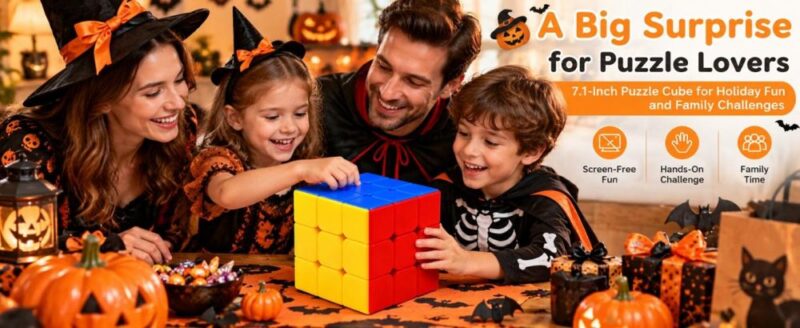
This is the largest cube on the list, and its size is the main reason to pick it. Each face is built from a 3×3 grid of pieces, but at 18cm (about 7.08 inches) per side, the pieces are big enough for small hands to grip and turn without much effort. The stickerless design means the colors are molded into the pieces rather than applied as stickers, so there is nothing to peel or wear off.
The 18 cm (approximately 7.1-inch) size also gives this cube a real wow factor. Compared with a typical handheld puzzle, it looks impressive as a birthday or holiday gift and stands out in a quick product demonstration. Its bold colors and giant proportions make the classic 3×3 challenge feel fresh.
For families, the appeal goes beyond individual solving. Kids and adults can take turns, challenge each other to complete a face, or figure out a sequence together. It’s an easy screen-free activity for a family game night or a rainy afternoon, while still encouraging the careful thinking that makes puzzle cubes rewarding.
Key features:
- Oversized 18cm 3×3 stickerless body
- Large-format twist puzzle suited to younger solvers and to anyone who prefers a bigger grip
- Single-piece build, sold as one cube
Things to know: Reviewers are split on the feel. Some describe the turning as smooth, while others say it is stiff, and durability reports range from very sturdy to loose after regular use. Customer photos also tend to make the cube look smaller than it is, so check the dimensions before ordering. If you want to shop for it directly, you can find it here: https://www.amazon.com/gp/product/B09L77YZZQ.
2. Classic Rubik’s 3×3 Cube
The original 3×3 is the reference point for the whole category. Its six colored faces, nine stickers each, and 43 quintillion possible arrangements make it a complete challenge for a beginner. Learning a basic method, such as solving one layer at a time, teaches you to break a big problem into smaller steps, which is the core of logical reasoning. It is also inexpensive and easy to find, so it is a sensible first cube for most people.
3. Pyraminx Triangular Puzzle
The Pyraminx swaps the square faces for a tetrahedron, which gives it a different geometry and a different kind of challenge. Each of its four triangular faces has its own set of tips, and the four tips on the corners can be twisted independently. That independence makes it a good choice for kids who are ready to move past the basic cube and want to practice spatial thinking with a new shape.
4. Megaminx Dodecahedron Puzzle
The Megaminx is a dodecahedron with twelve pentagonal faces, and it takes much longer to solve than a standard cube. Its size and number of pieces mean you have to keep track of more colors and edges at once, which trains working memory and patience. It is best for solvers who have already mastered the 3×3 and want something that will hold their attention for weeks.
5. Skewb Corner-Turning Cube
The Skewb looks like a cube but turns differently. Its rotating axes pass through the corners instead of the face centers, so every move changes the arrangement in a way that is easy to misjudge at first. That makes it a useful exercise for cognitive flexibility, because you have to stop applying the habits you built on a standard cube and think about the new rules. It suits adults who already enjoy puzzles and want a fresh challenge.
6. 2×2 Pocket Cube
The 2×2 is the smallest cube in the lineup. It has only eight corner pieces, so it can be solved in a few minutes, and it fits in a pocket. Its low difficulty makes it a good tool for short focus breaks at school or work, and it works well as a first step for a child who finds the 3×3 discouraging. Solving it regularly builds confidence before moving to larger puzzles.

Puzzle cubes are not only for children; many adults use them to keep their minds active.
What the Research Suggests
Research on cube solving is still early, but several studies point in a useful direction. A 2023 study in the Journal of Intelligence trained novices to solve the Rubik’s Cube with a standardized seven-step method. The researchers found that abstract reasoning and spatial ability predicted how efficiently and accurately people learned the skill, which suggests the cube rewards the same kind of reasoning that schoolwork relies on. A separate study of eighth-grade students, available through the University of Minnesota research repository, found that students who trained on the Rubik’s Cube improved their two- and three-dimensional mental rotation scores. These results do not prove that a cube will raise anyone’s intelligence, but they support the idea that regular practice builds specific spatial and reasoning skills.
Choosing the Right Cube for You
Start with the cube that matches your current ability rather than the one that looks most impressive. A large stickerless cube helps younger children and anyone who wants an easy grip. The classic 3×3 is the best all-round choice, the Pyraminx and Skewb add variety, the Megaminx rewards patience, and the 2×2 is ideal for quick sessions. Mix two or three of them over a few months and you will notice that each one trains a slightly different part of your attention.
A Practical Way to Get Started
Set a short daily routine of ten to fifteen minutes, and keep a simple log of your times or the number of moves you needed. Watching your own progress is often the most motivating part. Puzzle cubes do not need to be a race, so focus on understanding each move rather than on speed. Over time, that habit of working through a problem calmly and methodically is what carries over into everyday decisions.